Cleanup, Not a New Face: Where I Draw the AI Line in Portrait Retouching
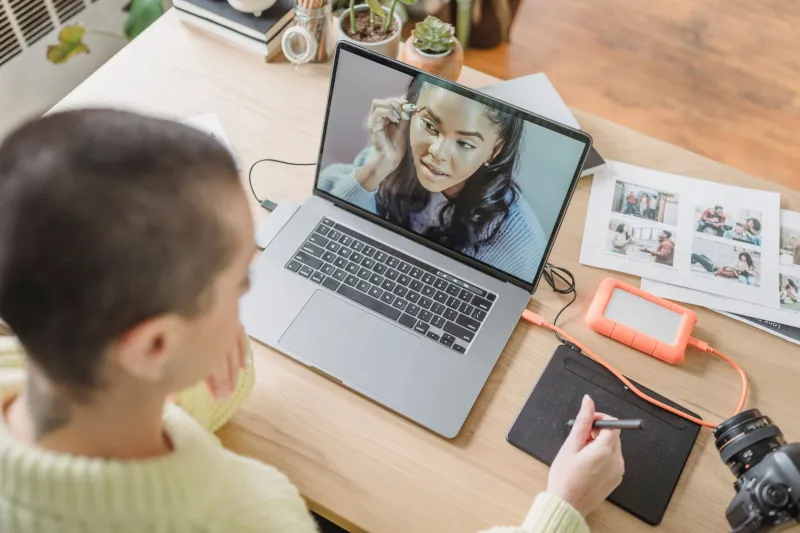
In 2026, the retouch conversation no longer starts with “Can you smooth this?” It starts with “Can the AI just fix it?” The tools are faster, cheaper, and more convincing than they were a few years ago, and that is exactly why photographers need a clear answer ready. Mine is simple: I will clean up a portrait. I will not invent a new person inside it.
That distinction sounds obvious until a client asks you to shave ten pounds off a jawline, erase a lifelong mole, or swap a tired expression for a brighter one. AI makes those requests feel like small slider adjustments. They are not small. They change the story of the face.
Cleanup Is Not the Same as Reconstruction
Cleanup is temporary. A pimple that showed up on Tuesday, a speck of lunch on a collar, a stray hair cutting across an eye, a bruise from a clumsy week—those are fair game. They are visitors, not residents. Removing them does not change who showed up to the session.
Reconstruction is different. It changes the architecture of a person: face shape, eye size, skin texture, hairline, smile, age, body proportions. AI is very good at reconstruction now. It can predict what a “better” version of someone might look like and then generate it. That is a technical marvel and a terrible default for portraits.
My working rule is not perfect, but it keeps me honest: if a feature would be gone in two weeks, I will consider removing it. If it has been there for years, it stays unless the client specifically asks and understands what we are trading away.
The Things I Preserve on Purpose
I preserve freckles. I preserve moles, scars, laugh lines, and the little asymmetries that make a face recognizable to the people who love it. I preserve skin texture, because skin is not a plastic surface. I preserve the shape of the eyes and the way a smile pulls more to one side. I preserve age, because age is not a flaw in a portrait; it is part of the record.
That does not mean every image ships raw. I still manage color, contrast, exposure, and distracting elements. I will soften a shadow that came from my lighting setup. I will remove a fire exit sign growing out of someone’s shoulder. I will clean up a temporary scrape. The goal is not zero retouching. The goal is zero erasure.
Have the Retouch Talk Before the Shutter Clicks
Retouching expectations should not be a surprise after delivery. I put a short, plain-language section in my portrait agreement: standard cleanup is included; heavy reconstruction is not. I also ask two questions during the pre-session call: What do you want to see preserved? What would make you feel unlike yourself?
Those questions do more work than a paragraph of technical language. A client might say, “Please do not remove my freckles,” or “I have a scar I’m fine with,” or “I hate my double chin in photos.” That last one opens a useful conversation about posing, camera angle, and lighting—not just the eraser tool.
I also show samples. Not a maximal before-and-after that makes the “after” look like a different person, but a normal cleanup: temporary blemish removed, skin texture intact, expression unchanged. Clients relax when they can see that retouching is not an all-or-nothing switch.
Why AI Makes the Line Harder
Traditional retouching required deliberate work. If you wanted to reshape a jaw, you had to make many small moves and own the result. AI makes the same change one click away, and it often looks smoother than a human edit. That convenience is dangerous. It encourages us to fix things we never would have bothered to fix before.
AI also invents. It does not just remove a distraction; it predicts what should be there instead. That is useful for a street sign and risky for a face. A generated patch of skin may look clean, but it may also erase the texture that tells a viewer this is a real person in real light.
Restraint Is a Trust Signal
In a market flooded with glossy, same-face portraits, restraint stands out. Clients can feel when an image has been overworked. They may not know the terms, but they know the result feels uncanny or overly polished. A portfolio with real skin, real expressions, and consistent retouching reads as honest. That honesty is a trust signal, not a technical limitation.
When I tell a client I will not slim their face by default, I am not saying I lack the skill. I am saying I have a point of view. The portrait is supposed to look like them on a good day, not like a stranger on a better day.
When a Client Pushes Back
I listen first. Sometimes the request is really about insecurity, and insecurity deserves compassion, not a lecture. If someone wants a temporary blemish gone, we do it. If someone wants an expression swapped or their body reshaped, I explain the trade and offer alternatives: a different crop, a stronger pose, a lighting adjustment, a wardrobe change next time.
If the request crosses into identity erasure, I decline. I would rather lose a booking than deliver a portrait that makes someone flinch when they see it. That sounds dramatic, but it is practical. My name is on the frame.
The Line Is the Service
The retouch I refuse is not a rejection of technology. It is a promise about what a portrait is for. A portrait should carry the person forward, not sand them down into a template. In 2026, with AI capable of almost anything, the most valuable edit may be the one I do not make.